
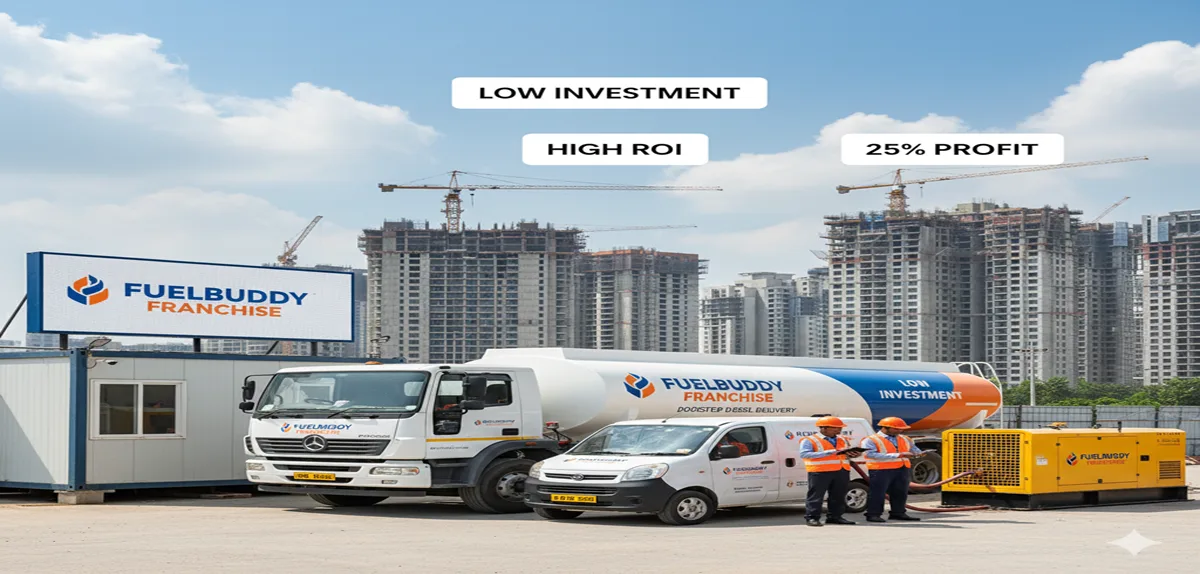
A logistics entrepreneur in Mumbai receives an urgent bulk diesel request from a construction company. Instead of wasting hours in long queues at conventional petrol pumps, he simply places an order through an app — and within hours, a fully monitored IoT-enabled mini-tanker arrives directly at the site, delivering clean, metered fuel with complete transparency. This efficient and tech-driven solution is the hallmark of FuelBuddy, India’s pioneering doorstep fuel delivery platform that is transforming how businesses manage energy needs.
Founded in 2016 by Adnan Kidwai, Divij Talwar, Gautam Malhotra, and Sumit Narvar, FuelBuddy has emerged as one of the most innovative names in the energy-tech ecosystem. The brand’s rapidly growing FuelBuddy franchise model is helping entrepreneurs tap into a booming sector by solving long-standing industry challenges like fuel adulteration, pilferage, unsafe handling, and unpredictable procurement. With a structured and scalable business setup, transparent systems, and competitive FuelBuddy franchise cost, the brand offers a modern, profitable entry point into the future of on-demand fuel delivery in India. As of 2025, FuelBuddy serves 130+ cities, has completed millions of litres of delivery, and is backed by major investors such as RJ Corp, JSPL, and Naveen Jindal Group.
FuelBuddy Franchise Cost & Investment Breakdown
FuelBuddy offers multiple business models for franchise partners. According to its official franchise deck, you can join as a mobile fuel delivery partner or operate a stationary refueling kiosk / pump.
Here’s how the investment typically breaks down:
| Franchise Model | Estimated Investment |
|---|---|
| Mobile Fuel Delivery (Bowser / Refueler) | ₹ 3.5 lakh – ₹ 5 lakh |
| Fuel Pump / Smart Tank / Kiosk (Stationary Model) | ₹ 1.5 crore – ₹ 2 crore |
Breakdown of Key Cost Components:
-
Vehicle / Bowser Cost: For mobile delivery, obtaining a PESO-approved tanker is critical.
-
Fuel Storage Infrastructure: Smart tanks, DOT (“Diesel on Tap”) systems, IoT-enabled monitoring.
-
Licensing & Compliance: FuelBuddy provides support in obtaining PESO approvals, permits, and other legal paperwork.
-
Technology Integration: Franchisees use FuelBuddy’s proprietary tech stack (app, backend, real-time dashboards) to manage orders and inventory.
-
Marketing & Support: FuelBuddy offers branding, training, sales & operations assistance.
-
Working Capital: Buffer for initial operations, fuel procurement, vehicle maintenance.
FuelBuddy Business Models & Revenue Streams
FuelBuddy’s franchise model is more than just fuel delivery. It provides a diversified revenue framework:
Franchise Models
-
Mobile Fuel Delivery Franchise
-
Use a bowser (refueler) to deliver diesel to B2B clients (factories, telecom towers, logistics hubs).
-
Scalable by adding more bowser units.
-
-
Loader / Kiosk Model (Fuel Pump)
-
Operate a smart fuel kiosk or stationary tank with real-time IoT monitoring.
-
Ideal for high-density industrial or commercial areas.
-
-
Smart-Tank / Buddy-Can Business
-
Sell “Buddy Cans” – smaller fuel containers to businesses or local buyers.
-
Install and manage smart tanks (“Diesel on Tap”), earning over time.
-
Revenue & Commission Structure
-
Commission on Fuel Delivered: Franchisees earn a commission per litre of diesel delivered.
-
Technology & Monitoring: Use of FuelBuddy’s app/dashboard to manage deliveries provides efficiency, reducing operational waste.
-
Value-Added Services: Income from buddy cans, smart tanks, DOT systems.
-
Possible Lubricant Sales: FuelBuddy has partnered with HPCL to deliver lubricants, providing an additional revenue stream.
Financial & Profitability Forecast: ROI, Margins, Payback
Understanding financial potential is key for any franchisee. Based on available data:
Expected ROI & Payback Period
-
ROI (Return on Investment): FuelBuddy’s franchise deck states that ROI starts from ~25% annually.
-
Break-even Timeline: According to Franchise India, franchisees typically break even in 2–4 years, depending on the business model and market.
-
Revenue Range:
-
Annual turnover for a small mobile franchise is quoted as ₹8.4 lakh (~₹ 840,000) to ₹1.2 crore (₹ 12,000,000), depending on location & scale.
-
Larger operations (kiosk or multiple bowsers) have higher potential.
-
Key Profit Drivers & Risks
Profit Drivers:
-
Recurring B2B demand from construction, telecom, logistics, hospitality.
-
Low running cost compared to traditional petrol pumps (no retail forecourt, lower staffing, lower capex for land).
-
Technology efficiency: IoT, order tracking, and cloud dashboards reduce fuel theft / misuse.
-
Scalability through multi-bowser operations.
Risks & Considerations:
-
Regulatory Compliance: Fuel operations need PESO approval, which can be rigorous.
-
Fuel Price Fluctuations: Diesel price changes and fuel margins may affect profitability.
-
Vehicle Maintenance: Bowsers / tanker upkeep is critical.
-
Competition: Other fuel delivery startups or traditional fuel infrastructure could compete.
-
Demand Variability: Profit depends heavily on securing steady B2B clients.
Market & Competitive Landscape
Market Context & Growth Opportunity
-
The Indian high-speed diesel (HSD) market is massive. According to FuelBuddy’s leadership, the HSD market is valued at USD 100 billion, and the doorstep delivery model could potentially address ~26% share, implying a USD 26 billion opportunity.
-
FuelBuddy has grown through both organic expansion and strategic acquisition: in 2021, it purchased MyPetrolPump, expanding reach into more geographies and customer segments.
-
FuelBuddy’s backing from major investors (RJ Corp, JSPL, Naveen Jindal Group) gives it financial strength for further scaling.
Competitive Comparison
Let’s compare FuelBuddy with traditional petrol pump franchise models and other fuel delivery / energy-tech businesses:
| Business Type | Investment Range | Strengths | Challenges / Risks |
|---|---|---|---|
| FuelBuddy Franchise (Mobile or Kiosk) | ₹ 3.5 L – ₹ 2 Cr | Tech-driven, scalable, B2B demand, lower capex for land | Regulatory compliance, fuel margins, fleet maintenance |
| Traditional Petrol Pump Franchise / Dealership | Several Crores (land + infrastructure) | Long-standing business, brand recognition | High capex, staffing, fuel theft, compliance costs |
| Other Fuel Delivery Startups | Variable | Similar model, but often smaller scale | Fragmented competition, weaker tech / coverage, funding risk |
FuelBuddy’s unique value lies in combining logistics, fuel supply, and technology — making it more scalable than a pump franchise and more stable than purely on-demand fuel apps without scale.
Why Invest in a FuelBuddy Franchise: Opportunities & Strategic Advantages
Key Investment Opportunities
-
White Space in Fuel Delivery
-
Many industrial areas, construction sites, and fleet operators still rely on manual fuel procurement. FuelBuddy addresses this gap.
-
-
Recurring B2B Demand
-
Fuel delivery to enterprises (telecom towers, warehouses, hotels) offers stable, high-volume orders.
-
-
Tech-First Business
-
IoT + cloud dashboard helps optimize inventory, reduce wastage, and build trust with clients.
-
-
Multi-Stream Revenue
-
Beyond fuel delivery: smart tanks, buddy cans, lubricant delivery (via HPCL tie-up).
-
-
Scalable Model
-
Start with one bowser and add more, or expand into kiosk operations.
-
-
Low Barrier Compared to Petrol Pumps
-
No need to invest in large land plots for a forecourt; significantly lower infrastructure cost.
-
-
Support & Training
-
FuelBuddy provides onboarding, regulatory assistance, tech training, and operational support.
-
-
Strong Funding & Credibility
-
Backed by established industrial groups, making it attractive for banks / lenders.
-
Risks to Watch
-
Regulatory Risk: High. Fuel operations are tightly regulated; PESO compliance is mandatory.
-
Capital Risk: Higher capex for larger models (kiosk) may strain finances.
-
Operational Risk: Managing a fleet of tankers, safety protocols, and maintenance.
-
Market Risk: Competition from other startups or traditional fuel infrastructure.
-
Demand Risk: If you cannot sign B2B contracts, volume may be insufficient.
-
Technology Risk: Dependence on FuelBuddy’s platform; any disruption could impact operations.
Step-by-Step Application Process: How to Get a FuelBuddy Franchise
Here’s a simplified roadmap to applying for a FuelBuddy franchise:
-
Initial Research & Inquiry
-
Visit FuelBuddy’s franchise website or request their franchise deck / brochure.
-
Reach out via their official contact: FuelBuddy lists their support at support@fuelbuddy.in and phone +91-8088994444.
-
-
Determine the Model You Want to Operate
-
Decide between mobile bowser-based fuel delivery or a fixed kiosk (or both).
-
Assess local demand, B2B opportunities, and cost feasibility.
-
-
Financial Planning & Investment
-
Prepare your capital plan: for mobile model estimate ₹ 3.5–5 lakh, for kiosk ₹ 1.5–2 crore.
-
Explore funding options: personal equity, business loans, or partnerships.
-
-
Regulatory & Compliance Setup
-
Work with FuelBuddy to obtain PESO approval and necessary licenses.
-
Set up banker relations, insurance, and safety protocols.
-
-
Tech Integration & Training
-
Undergo training for using the FuelBuddy platform, app, and dashboard.
-
Schedule IoT configuration on tankers / smart tanks for real-time monitoring.
-
-
Operations Planning
-
Hire or assign staff (drivers, tanker crew, operations).
-
Build relationships with local B2B clients (logistics, SMEs, telecom, industries).
-
Plan marketing: local outreach, digital, app-based promotions.
-
-
Launch & Go-Live
-
Begin operations with initial delivery orders.
-
Use FuelBuddy’s marketing and sales support for client acquisition.
-
Monitor performance via FuelBuddy’s dashboard, optimize routes, and delivery schedules.
-
-
Scale & Expand
-
Evaluate adding more bowsers or branching into smart tanks or kiosks.
-
Work with FuelBuddy to expand your delivery footprint or invest in new verticals (e.g., lubricants).
-
FuelBuddy vs Competitors: Comparative Analysis
Let’s compare FuelBuddy’s franchise opportunity with other business models in the fuel / energy space.
| Model | Strengths | Challenges |
|---|---|---|
| FuelBuddy Franchise (Mobile + Kiosk) | Low land cost, tech-driven, scalable, B2B recurring demand, flexible funding | Regulatory risk, fleet management, capex for infrastructure |
| Traditional Petrol Pump (Dealer / Franchise) | Established infrastructure, fuel footfall, brand legacy | Very high capex, land costs, manpower cost, theft / pilferage risk |
| On-Demand Fuel Startups (Non-Franchise) | Lean model, app-only, minimal capex | Harder to scale, limited control, risk of cash burn, dependence on external funding |
FuelBuddy occupies a niche but high-potential space: it bridges traditional fuel retail and tech-driven delivery, offering entrepreneurs a future-forward play with tangible demand.
Conclusion & Call-to-Action
FuelBuddy’s franchise model represents a smart, modern, and scalable way to tap into India’s massive fuel economy — especially the B2B segment that values convenience, safety, and technology. With investments starting as low as ₹ 3.5 lakh for mobile delivery, and strong ROI projections (≥ 25%), this is not just an energy business — it’s an energy-tech play.
The model’s strengths are clear:
-
Low barrier to entry (compared to traditional petrol pumps)
-
Recurring business from B2B clients
-
Technology-first operations, reducing wastage and improving scale
-
Diversified revenue via smart tanks, buddy cans, and lubricant delivery
But like any business, risks remain — regulatory compliance, fleet costs, and securing stable demand are all critical levers.
If you’re an ambitious entrepreneur or investor looking for a scalable, future-forward franchise opportunity, FuelBuddy could be your gateway into the energy delivery revolution.
Next Steps:
-
Reach out to FuelBuddy’s franchise team at support@fuelbuddy.in or +91-8088994444.
-
Request their latest Franchise Deck / business prospectus to deeply analyze the investment and model.
-
Build a detailed business plan with funding, regulatory strategy, and client acquisition in mind.
-
Start small, pilot in your region (via a bowser), and scale over time as you validate demand.
FAQ Section: People Also Ask
Q1: How much does it cost to start a FuelBuddy franchise?
A: The cost depends on the business model. For FuelBuddy’s mobile fuel delivery (bowser), the investment is approximately ₹ 3.5–5 lakh. For a fuel pump or smart tank / kiosk model, the investment ranges from ₹ 1.5 crore to ₹ 2 crore.
Q2: What is the expected ROI for a FuelBuddy franchise?
A: According to FuelBuddy’s franchise deck, ROI starts from around 25% annually. fuelbuddy.in Break-even typically occurs within 2–4 years, depending on scale and model.
Q3: What kind of support does FuelBuddy provide to its franchisees?
A: FuelBuddy supports franchisees across legal, technical, and marketing fronts:
-
Assistance with PESO licensing and compliance.
-
Training for operations, technology, and fleet management.
-
Marketing, branding, and lead generation support.
-
Access to their IoT-enabled app/dashboard for monitoring and managing deliveries.
Q4: Do I need prior experience in the fuel or logistics industry to become a FuelBuddy franchisee?
A: No prior experience is strictly necessary. FuelBuddy’s model is built for entrepreneurs with business acumen; they provide comprehensive training, regulatory assistance, and a tech platform to run operations effectively.
Q5: Can I expand my FuelBuddy franchise with multiple bowsers or a smart tank business?
A: Yes. One of the biggest advantages of FuelBuddy’s model is scalability. Franchisees can start with one bowser and expand to multiple delivery units, or diversify into smart tanks (“Diesel on Tap”), buddy cans, or even kiosk operations.
Thanks for visiting our Franchise blog, check out our previous article on:
- Ajmera Fashion Franchise
- Lakme Franchise Cost
- Wayback Burgers Franchise Cost
- Travelin’ Tom’s Coffee Franchise Cost
- iSmash Franchise Cost 2025
- Dryer Vent Wizard Franchise Cost
- Tierra Encantada Franchise Cost
- Yazu Goa Franchise
- Atul Bakery Franchise Cost
- Yousta Franchise Cost
- Chaayos Franchise Cost
- Fantastic Sams Franchise
- Cantabil Franchise Cost
- Kake Di Hatti Franchise
- Marco’s Pizza Franchise Cost
- VLCC Franchise Cost
- EuroKids Franchise Cost
