
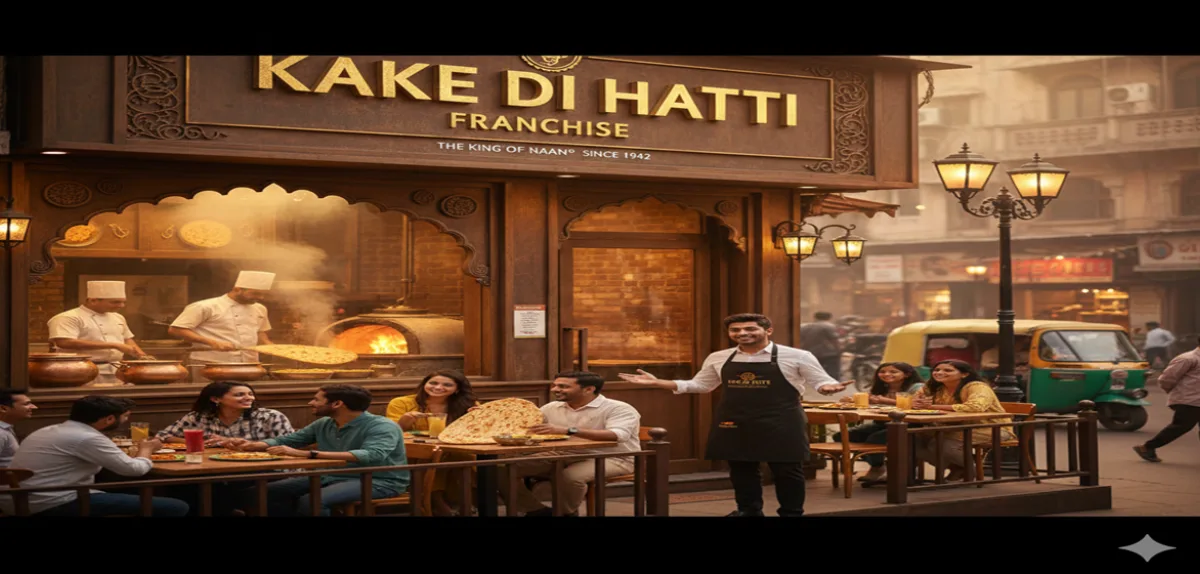
Picture a narrow alley in Old Delhi, the air thick with the aroma of freshly baked naan, simmering dals, and centuries-old spices. That’s where Kake Di Hatti, the “King of Naan®,” first opened in 1942. Founded by Sardar Bhagwan Singh and named after his young son “Kaka,” this iconic eatery has become a culinary institution. Recognizing the nationwide demand for their legendary recipes and unparalleled quality, the family launched the official Kake Di Hatti franchise, transforming the heritage brand into a scalable business with over 100 thriving outlets across India, delivering its legacy to cities far beyond Chandni Chowk.
Why the Kake Di Hatti Franchise Is Poised for Growth
Market Context & Global Trends
-
The global franchise market was valued at around USD 146 billion in 2025 and is expected to grow to nearly USD 370 billion by 2035, with a CAGR of 9.7%.
-
According to the International Franchise Association (IFA), in 2025, the number of franchise locations is projected to grow 2.5% globally, with fast-food / quick-service restaurant (QSR) franchises generating USD 322 billion in economic output.
-
On the home front in India, the foodservice market is booming — a report by Fortune Business Insights estimates it will grow from USD 78 billion (2024) to USD 125 billion by 2029 (CAGR ~10%).
-
According to Brands & Branches, the organized food & beverage franchise market in India is expected to cross ₹5 lakh crore (~USD 60 billion) by 2025, fueled by growth in tier-2 and tier-3 cities.
Take-home insight: Franchising in the food business is not just growing — it’s outpacing broader economic growth, and Kake Di Hatti, with its heritage brand equity, is well positioned to ride that wave.
The Kake Di Hatti Brand: Legacy, USP & Reach
A Legacy Brand with Authentic Roots
-
Established in 1942 in Chandni Chowk, Delhi.
-
Family-run across four generations; current leadership includes Gurdeep Singh.
-
Branded as the “King of Naan®” thanks to its oversized naans in up to 100+ varieties and sizes (Nikka, Baby, Kake).
-
Uses traditional cooking methods with a special blend of herbs and spices, including Hamam Dasta.
Business Model & Footprint
-
Offers both dine-in and express models (takeaway / delivery).
-
According to their website, there are over 100 Kake Di Hatti outlets across India.
-
Franchising is available via a FOFO (Franchise-Owned, Franchise-Operated) model.
-
Support includes design, layout, staffing, centralized kitchen, live counters, and training.
-
Franchise enquiry is direct via their website.
Vision & Growth Ambitions
-
According to the Telegraph, the brand already has 11 franchises in India with plans to expand to 400 outlets nationally.
-
They have also trademarked “Kake Naan®” globally.
Kake Di Hatti Franchise Cost and Investment Breakdown
The Kake Di Hatti franchise operates primarily on a Franchisee Owned, Franchisee Operated (FOFO) model, meaning the franchisee bears the entire initial investment for setup and operation, but retains a significant portion of the business revenue.
The Kake Di Hatti franchise cost is highly competitive for a full-service, established QSR brand in the Indian market. The total Kake Di Hatti investment generally ranges from ₹35 Lakhs to ₹60 Lakhs, though this varies significantly based on the chosen franchise model, location (Tier 1 vs. Tier 2 city), and the required space.
Investment Analysis by Franchise Model
Kake Di Hatti offers flexible models tailored to market size and investor capacity: the compact Express Model and the larger Restaurant Model.
| Expenditure Type | Express Model (Approx. 400 Sq. Ft.) | Restaurant Model (Approx. 1000–2000 Sq. Ft.) | Notes on Investment |
| Initial Franchise Fee (One-Time) | ₹10 Lakhs + GST | ₹14 Lakhs + GST | Fee for brand rights, training, and operational manuals. |
| Store Setup/Infrastructure Cost | ₹10 Lakhs – ₹15 Lakhs | ₹20 Lakhs – ₹30 Lakhs | Includes interiors, furniture, fixtures, and civil work. |
| Equipment & Kitchen Setup | ₹8 Lakhs – ₹12 Lakhs | ₹15 Lakhs – ₹20 Lakhs | Commercial burners, refrigeration, specialized tandoors for naans, and Hamamdasta equipment. |
| Initial Inventory/Raw Materials | ₹2 Lakhs – ₹3 Lakhs | ₹3 Lakhs – ₹5 Lakhs | Opening stock, subject to local supply costs. |
| Working Capital (3 Months) | ₹5 Lakhs – ₹10 Lakhs | ₹10 Lakhs – ₹15 Lakhs | Funds for staff salaries, utilities, rent deposit, and initial marketing. |
| TOTAL ESTIMATED INVESTMENT | ₹35 Lakhs – ₹45 Lakhs | ₹55 Lakhs – ₹85 Lakhs | The actual cost is heavily dependent on location rental costs. |
Ongoing Royalty and Fees
The ongoing structure ensures continuous support from the franchisor in exchange for a share of gross sales:
| Fee Type | Express Model | Restaurant Model | Notes |
| Royalty Fee (Monthly) | ₹50,000 + Taxes (Fixed) | 7% – 8% of Gross Sales + Taxes OR ₹1 Lakh + Taxes (Fixed) | This fee covers ongoing R&D, brand consistency, and operational support. |
| Marketing Fee | Included in Royalty | Included in Royalty | Brand-wide and local promotional guidance provided. |
| Agreement Term | 5 Years (Renewable) | 5 Years (Renewable) | Standard term for established QSR franchises. |
A low royalty rate of 7% to 8% is highly attractive in the QSR industry, as many international competitors demand royalties between 10% and 15%. This structure allows the franchisee to retain a larger portion of the turnover, enhancing the overall Kake Di Hatti profit potential.
Profitability Forecast and Return on Investment (ROI)
The combination of low ongoing fees and a strong, recognizable brand directly impacts the financial outlook for a Kake Di Hatti owner. The business benefits from high repeat customer traffic and large average order values driven by their signature portion sizes.
Net Profit Margins and Revenue Potential
While specific financial performance is disclosed only in the Franchise Disclosure Document (FDD), industry data and franchisee reports suggest a robust financial model:
-
Gross Revenue: Due to the popularity of the brand, high-performing outlets in Tier 1 and Tier 2 cities can achieve significant daily sales figures, particularly from lunch and dinner rush hours, takeaway, and delivery platforms.
-
Net Profit Margin: The expected net profit margin on sales, after deducting Cost of Goods Sold (COGS), operating expenses (rent, salaries, utilities), and royalty, is estimated to be between 18% and 25%. The average projection stands around 20% net profit. This is considered highly healthy for the casual dining/QSR segment.
-
Anticipated Return: Some industry analysts suggest an anticipated percentage return on investment (ROI) reaching 75% over the life of the agreement, demonstrating the long-term value of the partnership.
Achieving a Rapid Kake Di Hatti ROI
The most critical factor for an investor is the payback period. Given the brand’s immediate recognition, the gestation period is significantly reduced compared to starting a new venture.
-
Payback Period: The estimated payback period, or time required to recoup the total Kake Di Hatti initial investment, is typically between 18 to 24 months.
-
Sales Target for Breakeven: Achieving breakeven quickly hinges on securing a prime location with high footfall, allowing the outlet to leverage its brand popularity from day one. Full-time owner involvement and efficient kitchen management are paramount to realizing this rapid Kake Di Hatti ROI.
Competitive Analysis: Kake Di Hatti vs. Indian QSR Competitors
To assess the true value of the Kake Di Hatti franchise opportunity, it’s useful to compare it against other established Indian food and QSR franchises.
| Franchise Name | Cuisine/Focus | Total Investment (Approx.) | Royalty Fee | Avg. Space Req. | Key Competitive Edge |
| Kake Di Hatti | North Indian Pure Veg (Naan USP) | ₹35 Lakhs – ₹60 Lakhs | 7% – 8% | 600 – 2000 sq ft | 80+ year legacy, low royalty, unique product. |
| Haldiram’s | Sweets, Snacks & Casual Dining | ₹1 Crore – ₹4 Crore+ | 4% – 8% | 1500 – 5000 sq ft | Massive scale, packaged goods synergy, high cost. |
| Jumbo King | Fast Food (Indian Vada Pav USP) | ₹15 Lakhs – ₹30 Lakhs | 8% | 200 – 400 sq ft | Low-cost entry, high volume, focused menu. |
| Rolls King | Rolls/Wraps QSR | ₹15 Lakhs – ₹25 Lakhs | 6% – 8% | 250 – 500 sq ft | Lower overall investment, limited menu specialization. |
The comparison demonstrates that the Kake Di Hatti franchise cost sits strategically in the mid-range—higher than small QSR kiosks but significantly lower than large-format family dining restaurants. Its primary advantage is coupling a moderate investment with the brand power usually associated with billion-dollar enterprises.
Localized Opportunities and Expansion Strategy
Kake Di Hatti’s current strategy focuses on PAN India expansion, particularly targeting high-potential areas:
-
Tier 1 & Tier 2 Cities: Expanding the presence in metro hubs (Mumbai, Bangalore, Chennai) and highly commercial Tier 2 cities (Pune, Hyderabad, Ahmedabad).
-
High-Street and Mall Locations: Prioritizing locations with high footfall and visibility for both the Restaurant and Express Models.
-
Food Court Integration: The Express Model is ideally suited for food courts and smaller retail spaces, offering flexible franchise opportunities to tap into transient consumer traffic.
Becoming a Kake Di Hatti Owner: The Application Process
The ideal Kake Di Hatti owner is a dedicated entrepreneur with a passion for high-quality food, robust operational management skills, and the financial capacity to meet the investment requirements.
Step-by-Step Franchise Application Guide
The journey to securing your Kake Di Hatti franchise license is systematic and thorough, designed to ensure quality control and brand consistency:
-
Initial Inquiry Submission: Complete the official franchise application form on the Kake Di Hatti corporate website.
-
Preliminary Meeting & Financial Review: The Franchise Development Team will contact the applicant for a detailed discussion on their profile, understanding the specific Kake Di Hatti franchise cost for their target city, and verifying the minimum liquid capital requirement.
-
Site Selection and Approval: The franchisee proposes potential commercial locations (minimum 600 sq ft is generally recommended). The franchisor provides detailed assistance in site analysis, lease negotiation, and final location approval based on demographic and traffic data.
-
Franchise Fee Payment & Agreement: Upon mutual agreement and site approval, the Franchise Agreement (typically 5 years) is signed, and the Franchise Fee (e.g., ₹14 Lakhs + GST) is paid.
-
Design, Layout, and Construction: The franchisor provides complete assistance with architectural design, kitchen layout, and procurement of specialized equipment (like the oversized tandoors) to maintain the brand’s aesthetic and efficiency standards.
-
Comprehensive Training: The Kake Di Hatti franchise and their core staff (including chefs) receive intensive, detailed training at the franchisor’s base kitchen in Delhi. This includes recipe adherence, operational manuals, inventory management, and customer service standards.
-
Sourcing and Supply Chain Setup: The franchisor facilitates the setup of the standardized, cost-effective supply chain, ensuring the authenticity of raw materials and ingredients across all outlets.
-
Pre-Opening Marketing & Grand Launch: The franchisee conducts a mandatory pre-opening marketing campaign and launch party, supported by the franchisor’s branding materials, before the official opening day.
Owner Profile and Eligibility
-
Financial Capability: Must meet the minimum investment threshold (liquid capital of ₹35 Lakhs+).
-
Location: Access to prime commercial property in a high-footfall area (600–2000 sq ft).
-
Operational Commitment: Willingness to follow the strict operational guidelines, adhere to the traditional recipes, and maintain high standards of hygiene and customer service.
-
Ideal Investor: Ambitious entrepreneurs, existing restaurateurs looking to diversify, or business entities seeking a high-ROI food sector investment.
Risks & Challenges to Consider
While the opportunity is exciting, prospective franchisees should also be aware of the risks:
-
High Capital Risk: ₹30–60 lakhs is a significant upfront investment; cash flow management is critical.
-
Inflation & Input Costs: Rising supply costs can squeeze margins (a common concern in many restaurant franchises).
-
Competition: Strong presence of QSRs, global brands, and local eateries.
-
Real Estate Risk: Rental and property costs may vary drastically by city or neighborhood.
-
Operational Complexity: Maintaining legacy recipes, quality control, staff training, and centralized kitchen logistics can be challenging.
Conclusion & Call to Action
Kake Di Hatti is more than a restaurant — it’s a living culinary legacy. As the “King of Naan®,” this brand combines generational authenticity with smart business potential. For entrepreneurs and food-service investors, a Kake Di Hatti franchise offers:
-
A proven legacy brand with deep consumer trust
-
Flexible business models (express or dine-in)
-
Attractive financials (20–25% margin, 18–24 months ROI)
-
Strong support from the franchisor (design, centralized kitchen, training)
-
Growth potential in both urban metros and emerging markets
If you’re ready to invest in a franchise that blends tradition with scale, now is a prime moment. Visit the Kake Di Hatti franchise enquiry page, fill out your details, and take your first step toward owning a piece of culinary history.
Become a part of the Kake Di Hatti legacy — serve India (and perhaps the world) the biggest, most beloved naan.
Frequently Asked Questions (FAQ)
-
How much does it cost to open a Kake Di Hatti franchise?
The total investment typically ranges from ₹30 to ₹60 lakhs, including franchise fee (₹12–14 lakhs), setup costs, inventory, equipment, and working capital. -
What is the expected ROI (Return on Investment) for a Kake Di Hatti franchise?
ROI is generally projected over 18–24 months for restaurant models and around 18 months for express models, assuming steady monthly sales and cost control. -
What are the royalty or ongoing fees for Kake Di Hatti franchises?
The standard royalty is 7–8% of gross sales, though there may be fixed royalty models (e.g., ₹50,000–1,00,000/month) in some cases. -
How many Kake Di Hatti outlets are there, and what is their expansion plan?
There are over 100+ outlets across India currently. Kake Di Hatti Their long-term vision includes up to 400 outlets nationally, per statements from leadership. -
How to apply for a Kake Di Hatti franchise?
Fill out the franchise enquiry form on the official Kake Di Hatti website, evaluate your city / location, secure financing, complete legal formalities, sign the franchise agreement, and then set up and launch with support from the brand team.
Thanks for visiting our Franchise blog, check out our previous article on:
- Ajmera Fashion Franchise
- Lakme Franchise Cost
- Wayback Burgers Franchise Cost
- Travelin’ Tom’s Coffee Franchise Cost
- iSmash Franchise Cost 2025
- Dryer Vent Wizard Franchise Cost
- Tierra Encantada Franchise Cost
- Yazu Goa Franchise
- Atul Bakery Franchise Cost
- Yousta Franchise Cost
- Chaayos Franchise Cost
- Fantastic Sams Franchise
- VLCC Franchise Cost
- Cantabil Franchise Cost
