
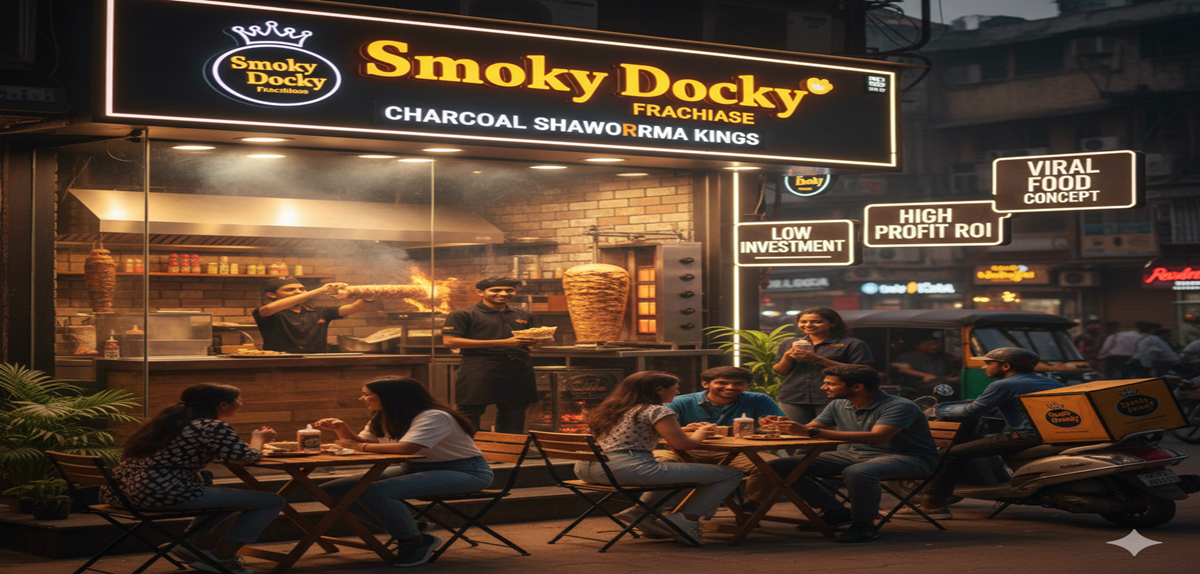
The Indian Quick Service Restaurant (QSR) sector is experiencing unparalleled growth, fueled by urbanization, disposable income, and the consumer’s relentless demand for exciting, affordable, and high-quality street food. Within this booming market, currently valued at over ₹2,800 Crore and growing at a Compound Annual Growth Rate (CAGR) of 15-20%, a new wave of specialized, concept-driven brands is emerging.
At the forefront of this trend is Smoky Docky, a brand that has rapidly captured the attention of Southern India’s food lovers. Launched by two passionate entrepreneurs, Kiran Sai Santosh and Anush Shetty, the brand’s unique selling proposition (USP) is simple yet brilliant: Shawarma cooked on charcoal. This innovation imparts a distinctive smoky flavor and aroma to the traditional favorite, instantly setting the Smoky Docky franchise apart from the competition.
What began as a single outlet has quickly evolved into a recognized, award-winning chain (Best Emerging QSR Chain of the Year – 2023, South India). For ambitious entrepreneurs, this brand offers a compelling opportunity: a proven product with viral appeal, a model optimized for high-volume transactions, and a manageable Smoky Docky franchise cost—making it one of the most exciting investment opportunities in the QSR space today.
Brand Story, Concept, and Market Context
Understanding the core concept behind Smoky Docky is crucial to appreciating its expansion opportunities and success in competitive urban markets.
The Distinctive Charcoal USP
The key to the brand’s rapid success lies in its culinary innovation. By grilling the marinated meat for their shawarmas over traditional charcoal, Smoky Docky achieves a depth of flavor that cannot be replicated by conventional gas or electric rotisseries.
-
Core Offerings: Finest charcoal-grilled Shawarmas (Chicken, Mutton, and vegetarian options like Falafel and Paneer), complemented by popular sides like delectable Churros, Falafel Rolls, Combo Fries, and Mocktails.
-
Customer Appeal: The menu balances Lebanese-style core products with fast-food favorites and unique desserts, ensuring broad appeal across various demographics.
-
Proof of Concept: Reports indicate that individual branches can churn out over 100 kilograms of Shawarmas daily, demonstrating extremely high throughput and customer demand.
Global and Indian QSR Landscape
The QSR model is intrinsically profitable due to standardized operations, low inventory holding, and high turnover.
-
Global Insight: The global Fast Food & Quick Service Restaurant Market is expected to reach $931.7 billion by 2027 (Statista), confirming sustained consumer appetite for speed and value.
-
Indian Growth: India’s QSR sector is rapidly formalizing. Brands that offer a niche product with a repeatable, hygienic model are primed for massive growth, exactly where the Smoky Docky franchise sits.
-
Target Audience: The brand operates during peak snacking and dining hours (typically 4:00 PM to 1:00 AM/2:00 AM), perfectly targeting the urban late-night and evening crowd, which has high disposable income.
Smoky Docky Franchise Cost and Investment Breakdown
The Smoky Docky franchise cost is highly competitive within the specialized QSR segment, making it accessible to single-unit franchisees and multi-unit operators. Based on available industry standards and comparable QSR models, the estimated total investment is structured around the brand’s asset-light, quick-service nature.
Initial Investment Range (Estimated)
The total estimated initial Smoky Docky investment for a standard unit falls between ₹10 Lakhs to ₹20 Lakhs, primarily depending on the city, the store model (kiosk vs. full-service QSR), and the required operational area.
| Cost Component | Investment Range (₹ Lakhs) | Notes |
| Franchise/Brand Fee | ₹3.00 – ₹5.00 Lakhs | One-time fee for brand license, training, and operational manuals. |
| Store Setup/Interiors | ₹5.00 – ₹10.00 Lakhs | Includes counter, seating (if applicable), lighting, and brand signage. |
| Equipment & Kitchen Setup | ₹4.00 – ₹7.00 Lakhs | Mandatory charcoal grill, vertical rotisserie, refrigeration, prep area, POS system. |
| Initial Inventory/Working Capital | ₹2.00 – ₹3.00 Lakhs | Buffer for raw materials (meat, produce, sauces) and initial staff salaries. |
| Miscellaneous/Marketing (Pre-Launch) | ₹0.50 – ₹1.00 Lakhs | Local marketing, licenses, and permits. |
| Total Estimated Investment | ₹14.50 – ₹26.00 Lakhs | (Mid-range estimate: ₹20 Lakhs) |
Space and Operational Requirements
-
Space Requirement: The ideal space for a high-turnover QSR is typically 150 sq. ft. to 300 sq. ft. for a compact, optimized kitchen and counter setup. Prime location near colleges, busy residential hubs, or high-street retail is crucial.
-
Staffing: A small, efficient team of 3 to 5 employees (Chef/Grill Master, Counter Staff, and Helpers) is usually sufficient for operations.
-
Franchisee Profile (Owner Details): The brand seeks dedicated entrepreneurs with strong local market knowledge, managerial skills, and a passion for customer service in the food industry.
Profitability Forecast and Return on Investment (ROI)
The financial potential of the Smoky Docky franchise is high, driven by the low average cost per transaction (Approx. ₹450 for two), high volume, and optimized labor model.
Revenue Model and Margin Analysis
QSRs generally operate on gross margins of 55% to 70% on prepared food items, but the net profitability relies on controlling the Food Cost (F&B) and operational efficiencies.
| Financial Metric (Estimated) | Target Value | Notes |
| Food Cost Percentage (F&B) | 30% – 35% | Controlled by centralized sourcing and standard portion control. |
| Gross Margin | 65% – 70% | High markup on specialty food items (shawarma, churros). |
| Franchise Royalty Fee | 5% – 8% of Gross Sales | Standard ongoing fee for brand usage and support (Exact percentage requires FDD). |
| Net Profit Margin (Estimated) | 15% – 20% | Target profit after all costs (Rent, Labor, Royalty, Utilities, etc.). |
Return on Investment (ROI) and Breakeven Period
The streamlined operations and high turnover of the QSR model contribute to a rapid recovery of the initial Smoky Docky investment.
-
Anticipated ROI: Industry benchmarks suggest the Smoky Docky ROI could be as high as 90% (based on comparable QSR models and the brand’s early success).
-
Payback Period: Due to low overheads and high volume, the likely payback period for the initial capital investment is projected to be between 1.5 to 2.5 years.
Competitive Benchmarking and Technological Integration
The success of any specialized QSR hinges on its ability to stand out and adapt. Smoky Docky excels in both.
Differentiation in the Food Market
Smoky Docky competes against both established national QSRs and local street food vendors.
| Feature | Smoky Docky | Established QSR (e.g., KFC) | Local Shawarma Vendor |
| Core USP | Charcoal Shawarma (Unique flavor) | Chicken/Burger (Standardized) | Traditional Gas/Electric Rotisserie |
| Hygiene/Branding | High, standardized QSR setup | Excellent, corporate-mandated | Varies widely, often inconsistent |
| Menu Diversity | Niche, but includes popular sides/desserts (Churros) | Broad, complex menu | Very limited, primarily shawarma |
Technology and Operational Support
The franchise system provides an operator with ready-made tools for success:
-
Centralized Sourcing: Ensures raw material quality and consistency across all units, maintaining the brand’s signature taste.
-
POS & Inventory Systems: Integrated software for streamlined billing, inventory tracking, and sales analysis, simplifying the day-to-day management for the franchisee owner details.
-
Online Presence: Leveraging major delivery platforms (Swiggy, Zomato) where the brand has already established strong ratings and visibility, maximizing the catchment area beyond the physical store.
Easy-to-Follow Smoky Docky Franchise Application Guide
The process to own a Smoky Docky franchise is typically structured and designed to ensure both the franchisee and the brand are aligned for success.
Step-by-Step Guide for Franchise Application
-
Initial Inquiry Form: Prospective partners must fill out the dedicated franchise inquiry form available on the official Smoky Docky website or via recognized franchise portals. This captures initial contact and financial intent.
-
Franchise Vetting & Disclosure: The franchise team reviews the application, financial stability, and relevant experience. Shortlisted candidates are then presented with the Franchise Disclosure Document (FDD) detailing the exact Smoky Docky Franchise Cost, royalty structure, and legal terms.
-
Financial & Location Approval: The applicant must secure the required Smoky Docky investment (liquid capital). Simultaneously, the corporate team assists in identifying and approving a strategic location (150-300 sq ft) with high footfall.
-
Agreement Signing & Fee Payment: Upon mutual consent, the Franchise Agreement is signed, and the one-time Brand Fee (part of the overall Smoky Docky Franchise Cost) is paid.
-
Store Build-out & Equipment Procurement: The franchisee manages the construction and interior setup as per the brand’s standardized design guidelines, while the corporate team coordinates the procurement of specialized equipment, especially the charcoal grill.
-
Comprehensive Training: The franchisee and the core staff receive mandatory training on food preparation (maintaining the “smoky” flavor), customer service, hygiene standards, and POS operation.
-
Grand Opening: The unit launches with pre-opening marketing support from the brand, marking the beginning of the Smoky Docky expansion in the new territory.
Conclusion & Call-to-Action
The Smoky Docky franchise offers a compelling opportunity for entrepreneurs seeking to tap into the growing popularity of smoky, grilled cuisine — without an overly burdensome capital requirement. With an investment range of ₹15–25 lakhs, attractive profit potential, and an operational model grounded in casual dining, it’s a relatively accessible and scalable business proposition.
However, success hinges on smart execution: selecting the right location, managing grill operations consistently, building a team that understands quality, and driving customer awareness effectively. For investors ready to commit to a 5–10 year franchise agreement, the returns could be significantly rewarding.
If you’re interested in learning more or taking the next steps toward a Smoky Docky franchise:
-
Reach Out: Visit their existing outlets (e.g., in Bangalore) and speak to franchise management.
-
Request Franchise Info: Ask for an FDD or equivalent document to understand costs, terms, and support.
-
Evaluate Financing: Prepare your capital structure and explore bank or investor funding.
-
Build a Business Plan: Lay out your market, sales projections, staffing, and operational strategy.
-
Commit & Launch: Once approved, set up, train, and open with an impactful launch.
Start your journey with Smoky Docky today — and build a sizzling business serving people the smoky flavors they love.
FAQ (People Also Ask)
Q1: How much does it cost to open a Smoky Docky franchise?
A1: The total initial investment is estimated between ₹15 lakhs and ₹25 lakhs, including franchise fee, setup costs, inventory, equipment, and working capital.
Q2: What is the royalty rate for Smoky Docky franchisees?
A2: Smoky Docky charges a royalty fee in the range of 3% to 8% of monthly sales, depending on the agreement.
Q3: How quickly can I make a profit in a Smoky Docky outlet?
A3: With estimated profit margins between 25%–40%, a franchisee can potentially recoup their investment in about 2–3 years.
Q4: What are the qualifications needed to apply for a Smoky Docky franchise?
A4: Ideal franchisees should have some food-sector experience (1–2 years is helpful), financial capacity to invest ₹15–25 lakhs, and ability to manage operational aspects like staffing and grill / kitchen operations.
Q5: What are the main risks in investing in a Smoky Docky franchise?
A5: Key risks include competitive pressure, operational challenges related to grilling and smoking, royalty burden, real estate costs, and uncertain demand in new regions.
Thanks for visiting our Franchise blog, check out our previous article on:
- Ajmera Fashion Franchise
- Lakme Franchise Cost
- Wayback Burgers Franchise Cost
- Travelin’ Tom’s Coffee Franchise Cost
- iSmash Franchise Cost 2025
- Dryer Vent Wizard Franchise Cost
- Tierra Encantada Franchise Cost
- Yazu Goa Franchise
- Atul Bakery Franchise Cost
- Yousta Franchise Cost
- Chaayos Franchise Cost
- Fantastic Sams Franchise
- Cantabil Franchise Cost
- Kake Di Hatti Franchise
- Marco’s Pizza Franchise Cost
- VLCC Franchise Cost
- EuroKids Franchise Cost
- FuelBuddy Franchise
- BigBasket Franchise Cost
